
If you lived in London all your life, you probably wouldn’t get to visit all the sights, landmarks, parks and pubs, so where do our enlightened world travelling bloggers recommend you should visit? For sure, they cover the main landmarks and sights, from the underground London Dungeon to the lofty London Eye. They venture into markets, little-known restaurants and historic pubs to provide eyewitness details about London’s foodie scene (well someone’s got to do it!). Of course, we cover some of London’s famous cultural museums, many with free admission making them a good pick for a rainy day!
The great thing about personal blogs is the wonderful insider info that they provide. Walking around London is a great way to absorb the atmosphere while spotting those discreet but informative Blue Plaques, but have you considered using the free London bike loan system? Whether you’re looking for amazing shopping destinations, dozens of famous film locations or an unforgettable Harry Potter Experience (including the authentic Platform 9¾!). London has something to suit muggles of all ages and interests, as you’ll see…
The iconic and timeless landmarks of London
London is one of the best and most popular places to visit in the UK because of the abundance of iconic attractions in the city. For example, if you think of England, what springs to mind? Most people are going to say the London Eye, Big Ben or Buckingham Palace, which are all examples of the iconic attractions that I’m talking about.
I’ve visited London countless times with my fiancé and my family, and even on a work-trip. It’s the kind of city where you can visit over and over again, and each time is a little different. Some of my favourite London attractions include the Shard (I love a skyscraper), the London Dungeons, the Tower of London, the West End, Trafalgar Square, St Paul’s Cathedral and Covent Garden. Of course, I also love King’s Cross and its iconic Harry Potter shop and dedicated platform 9 and ¾!
Of course, it’s not just attractions that instantly make you think of the British capital. A red phone box, black cab or palace guard are also icons that are visual must-sees when travelling to this European city. With so many sights to choose from, it’ll be hard to pick your favourite, but each is definitely a reason to add a holiday to London to your bucket list!
By Alice Smith from Adventures of Alice

I came from across the world to see London, solo!
Back in 2019 I went on my first solo trip from Australia to the UK. I spent about a month there exploring as much as I could! I love history and London is full of wonderful sights from all different periods of history. As a solo traveller I made sure to have everything set up so I would hardly have to wait for things. Using the London Pass gave me so many opportunities to see the sights I wanted! From castles to wax figures I found London has something for everyone!
As I explored the streets, I would see people waiting to go see a musical and people heading into the London Dungeon! The museums are a must to visit in London! If you don’t want to go to a historic museum there is an art museum right around the corner. You don’t even have to walk into a museum to see history as the Blue Plaques around the city tell you all about places you could have just walked past and never known.
Public transport is so easy to navigate in London making it easy for a first-time visitor. My experience in London was magical, I got to explore a city that has been so influential in the world. The wonder of London is that you can just keep walking and find something interesting whether it be a cool café or a statue of a monumental figure in history!
If you’re wanting a memorable holiday full of adventure, I suggest you visit London. I had an incredible time, so much so, that I could see myself living there!
By Claudia Hackney from The Travelling Voice

Visit London for an amazing foodie experience
London is known for its diversity and there’s no better example of it than when it comes to food. The capital is home to thousands of restaurants of every food ethnicity, so it’s a great place to visit for foodies. You can pick up quick and easy fast food anywhere in town, but also head off the beaten track a little and find superb Indian food in Brick Lane and London’s Chinatown provides an amazing array of different types of Chinese food.
More of an afternoon tea person? Why not take tea at the Ritz? Or even on a red London double decker Routemaster bus.
Some of the best food experiences are at London’s markets – Borough Market is famous for it! Old Spitalfields too, and has been since 1875!
Whether you’re visiting with the family or as a couple like us, London won’t leave you hungry, you’ll want to keep coming back for more. I know we did! London is a great opportunity to eat food that originates from a different country at every meal.
We ate Peruvian ceviche one night, and London’s original street food, Pie, Mash, and Liquor for lunch the next day. We enjoyed Moules Frites from Belgium another day and snacked on cockles and mussels on yet another day. There are heaps of London food tours you can take to explore the cuisine of the capital, but it’s also easy to make a list of places to eat and just head there, as we did.
Whatever you decide, taking a foodie adventure in London is a great way to explore!
By Sarah Carter from A Social Nomad

Three Hollywood blockbuster movie locations in London you can visit
I’m a Londoner and I love to explore the city and all it has to offer as there is always something new to do.
London Is one of the best places to visit in the UK, but something that you may not be aware of is that London has been the backdrop for many Hollywood blockbusters over the years. London has hosted secret agents, superheroes, stormtroopers and even zombies. If you are a movie buff like me and you want to visit London without breaking the bank you can visit these three locations and it won’t cost you a penny.
I choose these three locations to share with you because they are not only iconic locations in London, but they are all within a short distance of each other.
Piccadilly Circus
I love Piccadilly Circus, one of London’s busiest tourist Locations. It’s appeared in over 50 movies including everyone’s favourite wizard Harry Potter and the Deathly Hallows Part one, Tom Cruise’s Mission Impossible Rogue Nation, Bridget Jones Diary and Fast and Furious 6.
Piccadilly Circus is a short walk away from the theatre district, Leicester Square, Soho, Chinatown and a 7-minute walk to Trafalgar Square.
Trafalgar Square
Trafalgar Square has appeared in 48 movies to date which includes 101 Dalmatians, Captain America the First Avenger, 28 Weeks Later, Night at the Museum 3 and Wonder Woman just to name a few.
As well as being one of the most recognisable movie locations in the world, Trafalgar Square has plenty of photo opportunities. There’s plenty to see in Trafalgar Square including Nelson’s Column, the Trafalgar Square Lions, two fountains, various statues, the Trafalgar Square Police Box which was the smallest police station in London, The National Gallery and the Portrait Gallery. It’s a 13-minute walk to Somerset House.
Somerset House
If you are a fan of the 007 movies, Somerset House was in Tomorrow Never Dies and GoldenEye. Fun fact – in the movie GoldenEye, the courtyard passes off as St. Petersburg Russia.
Throughout the year Somerset House hosts many exhibits and events, so before you visit, check the website and see what events are happening that day.
By Lisa Legend from One Epic Road Trip

A taste of Christmas in London
London is full of magical spots, from landmarks to attractions and colourful houses. You simply cannot get tired of this city. Visiting bustling Regent Street, Carnaby Street and Oxford Circus each December puts a smile on my face as I get to see the amazing festive light displays.
All across town there’s always plenty of stunning festive shopfronts – one of my favourites is Bond Street with the likes of Cartier and Tiffany. Last year the Panther and gift wrap on Cartier’s shopfront was simply picture-perfect, straight out of a postcard I would say, such an eye-catching display!
The Royal Arcade is a pretty hidden spot that’s nearby, with shops on either side and a festive Christmas display I always enjoy walking through.
Walking down Piccadilly and seeing the facade of Fortnum and Mason decorated in the style of an Advent calendar makes me especially excited for the holidays. I also enjoy exploring the wonders of Covent Garden, with magical disco balls shining inside the market.
But the thing I especially love during December is the Christmas markets as I’m a huge foodie. I love getting to taste so many of the festive treats!
I highly recommend coming to London for a holiday in December. You have so many beautifully decorated areas to explore, light installations to see, markets to wander through and the chance to taste so many different cuisines from around the world… it’s just mind-blowing!
The list is endless when it comes to adventures and exploring London.
By Adil Musa
Cycling around London’s food courts and free museums
Visiting London should be on everyone’s bucket list. We’ve been to London on a weekend trip many times and loved every bit of it. The mixture between culture, great food and iconic sights can keep you entertained on many holidays.
During our last trip, we explored most of London by bike. The weather wasn’t that great – it’s London after all – but cycling around the city is the best way to see most of it. The public bicycle loan system was a great way to do so. You can just pick up a bicycle at one of the stations and drop them off at another.
One of us being the history geek and the other one a modern art lover, we visited both Kensington Palace for some royal history and the Tate for contemporary art and amazing views of London. The free museums are one of the great things about London. You can visit the Tate for free, just like the famous British Museum and – our favourites – the Victoria & Albert Museum with its fabulous jewellery collection and The Wallace Collection with its historic paintings.
Add the amazing food scene to all of that and you’ll get why London is the perfect destination for a holiday. The city is packed with amazing food courts, each one different from the other. Camden and Borough Markets are probably the most well-known, but hidden gems like Mercato Metropolitano on the South Bank are definitely worth a visit as well!
By Maartje & Sebastiaan from Tidy Minds

Walking London – it’s what all the cool kids are doing
I agree with Charlotte Bronte, who said, “I like the spirit of this great London which I feel around me”. And there is no better way to experience the spirit of London than by walking and immersing yourself in the sights and sounds of the most extraordinary city in the world.
We travel with two typical teenagers; they keep in touch with friends at home, take lots of pictures, create TikToks, and enjoy their rest. These two teens were utterly enamored by London!
London is a walkable city, and you will cover a ton of history, culture, royalty, and haunts all within walking distance. Here is what we accomplished on our best day, walking the City of Westminster, an inner London city and borough. Considered the younger sister of “The City”, Westminster is home to parks and royalty.
We strolled through St. James’s Park early one morning to arrive at Buckingham Palace in plenty of time to see the Changing of the Guards. We continued our day trek to Hyde Park, the largest green space in London and the home of Kensington Palace. Touring the Palace was at the top of my London bucket list, with special attention to Princess Diana’s famous garden.
Time for a burger and a brew for lunch at The Original Hard Rock Cafe, located right outside Hyde Park.
Afternoon tea is a must when in London, so after spending a little more time strolling through Hyde Park, we headed to Sketch Gallery in Mayfair for afternoon tea. We then discovered the absolute best view of London’s city at the top of the London Eye. And yep, you guessed it; we arrived on foot.
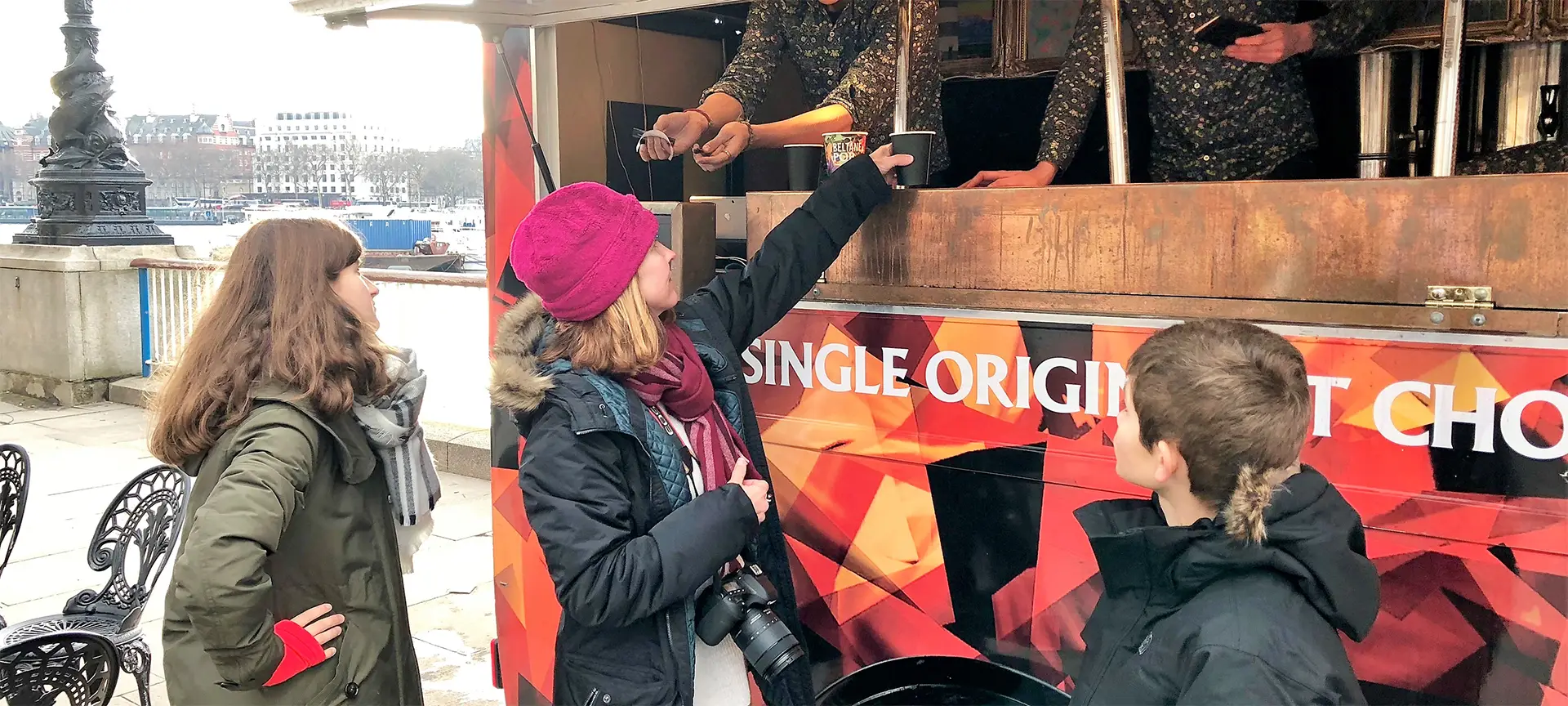
But that’s not all. You won’t believe the treasure we stumbled upon on our way back to our Southwark hotel after a long day exploring on foot — the Beltane&Pop hot whiskey truck. Put it on your bucket list, too, maybe at the top.
By Jennifer Bhatia from Traveling Party of Four
My Harry Potter London adventure
I am a huge Harry Potter fan! So of course, planning a trip to where it all began was a must! London is amazing and Harry Potter is incredible so putting those two things together is a perfect combination.
I planned the perfect Harry Potter London vacation! We started with a walking Muggle Tour and visited all the sites where the Harry Potter movies were filmed. Next on the list was Kings Cross Station where we accepted our letter to Hogwarts and pushed our trolley through platform 9¾. (There is an incredible souvenir shop with unique items that can’t be found anywhere else.)
The Warner Bros. Studio Tour Making of Harry Potter was by far the best experience in all of London. This tour takes about three hours. It is not an amusement park but more like a museum of all the props, sets, and costumes that were used in the Harry Potter films. There are also interactive experiences such as jumping on a Nimbus 2000 and flying, and hopping on the Hogwarts Express. About halfway through the tour you can try butterbeer, butterbeer ice cream, and chocolate frogs. The sets and props are incredible!
Make sure to book your tickets at the Official London theatre kiosk for the performance of The Cursed Child. This show is separated into Part 1 and Part 2 and are different shows. Each play needs separate tickets! Allow a day to see the plays because the total time to watch both plays is over five hours!
If you want to really immerse yourself in the Harry Potter London experience, book a room at the Georgian House Hotel. This hotel has amazingly themed rooms and Harry Potter experiences within the hotel.
I know there are a lot of other exciting things in London but for me it can’t get better than the Harry Potter London experience.
By Lisa Manderino from PlanningAway
Having a drink (or two) in London’s pubs
One reason why a holiday in London is a really cool thing is the cool pubs of the city, for sure! Believe me, I’m not really a beer drinker, but these pubs are so unique and have a long tradition. There’s hardly another city in the world where you will find so many unique pubs as in London. Also historically significant, London’s pubs used to be the haunt of prostitutes, thugs and booze-loving writers. But today they are the location for a casual meeting, whether business or socially with work colleagues and friends. We have even met some travel bloggers!
What I liked about London’s pubs is that the atmosphere is always really relaxed, and the beer is cool and tasty. Of course, there are other drinks, but you will rarely find coffee anywhere on the menu. But that doesn’t matter, it’s part of the program on a trip to London. Before sightseeing, as a break in-between sights, and after sightseeing, a visit to a pub is a must!
And best of all, you don’t have to search for long because you can find them on every corner. Anyway, my favorite ones are the Waxy O’Connor’s near Piccadilly, the Rose & Crown in Mayfair, the Cask & Glass near Buckingham Palace and the Plume of Feathers in Greenwich!
Another point, why I love the London pubs is that you can easily meet new people here. Whether locals or tourists, quite a few times you will get into conversation and meet like-minded people.
The only disappointing thing about London pubs was the “Last Order”, which is rung in many pubs as early as 22:45. Then it’s closing time, but the advantage of an early night is that you are fit for sightseeing again the next day.
By Martina & Jürgen from PlacesofJuma
London, now see it for yourself
Now all you need to do is find yourself a hotel in London!

Born in Cheshire, Gillian Birch moved to Cornwall at her earliest opportunity and never looked back. After 20 years, her ongoing discovery of popular attractions, quiet footpaths and local eateries has made her a fount of knowledge as she entertains readers with her informative articles on the hidden gems of Wales from a local point-of-view.